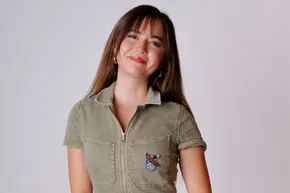

Mark Rober shares how Class CrunchLabs brings free, hands-on STEM lessons to grades 6-8, combining YouTube engagement with classroom science.
Sep 29, 2026 [[read-time]] minute read
Sep 29, 2026 [[read-time]] minute read
By 2030, CrunchLabs wants to be in 70% of U.S. classrooms. It’s a lofty goal, but so was planting 20 million trees, scooping 30 million pounds of plastic out of our oceans, and engineering a rover that landed on Mars.
If anyone can achieve the seemingly impossible, it’s Mark Rober.
Today, Mark unveils the first courses for Class CrunchLabs — “Carnival of Collisions” and “Mission Maglev” — on YouTube. With dozens of videos each alongside supplemental teaching resources and activities, these courses bring his signature hands-on science experiments directly into the classroom. Students can discover the physics of contact forces through carnival-style games, and explore how magnetic and electric forces can make a train float.
This is just the beginning. Over the coming months, Class CrunchLabs will release additional free, standards-aligned science courses for grades 6-8, developed in collaboration with other YouTube creators like ElectroBOOM and How Ridiculous, as well as organizational partners including the National Science Teaching Association, NASA, and more. The full program will feature more than 1,000 videos available in 34 languages.
We sat down with Mark to discuss the inspiration behind the project, how he brings YouTube engagement strategies into the classroom, and why this is the most important mission of his career.
Mark: I was at a coworker’s house and I asked his daughter what she’s learning in science. She showed me an old Bill Nye video and a worksheet that looked like it had been copied a thousand times. This generation grew up on YouTube, but classroom science hasn't evolved.
I realized I could do something to change that. I know how kids' brains work and what makes them excited. I've learned how to hide the vegetables—to make science interesting and engaging without making it feel like work.
Sometimes you get an idea that’s so big, it’s irresponsible not to follow through on it. So we said, let's take all those tricks and make a banger curriculum for 6th to 8th grade that exceeds all state science standards, costs us over $60 million to make, and then make it free forever. For the next four and a half years, one week out of my month is volunteering to make videos for Class CrunchLabs. It's a massive undertaking and a huge labor of love, but it will be the most important thing I do in my whole career.
Mark: There's literally no topic you can pick that we can't tackle. I think the distinction is that some things are just more interesting simplified.
We could talk about string theory to a five year old, but it's still kind of hard to wrap your head around. That explanation on its own isn't that interesting, versus something I learned recently: a chicken is closer to a T-Rex than a T-Rex to a Stegosaurus. Birds aren’t just relatives, they're defined as dinosaurs. That's fascinating because if you're eating dino nuggets, you're actually eating dinosaurs! That's a fascinating, fun way to wrap your head around the fact that dinosaurs live amongst us.
Mark: That's where hands-on learning comes in. It's no longer 'sage on a stage' where you just give them the answer. Product designers at CrunchLabs are designing fun activities that really get students' brains going. For example, in a unit about kinetic energy we aren’t just explaining the concept. We’re using a scenario: you’re in a truck and the brakes failed. What are you going to do? How are you going to stop? It spurs a discussion and we Scooby-Doo our way to the answer over two weeks.
It's hard to memorize an equation, but you remember every word to a song you sang as a teenager because it made you feel something. We're dealing with matters of the heart, getting them excited and creating visceral experiences. That's how the learning sticks.
Mark: We have an upcoming unit on potential energy called "Science Blob”. You know those big inflatable blobs on a lake where someone sits down, compresses the air, and launches the other person up. We're going to put a dummy on one, drop a real car on it, and see how high he flies!
For the kids in the classroom, the analog is a Ziploc bag and a paper crash-test dummy with paperclips for the head, legs, and arms. This becomes a G-force monitor for less than a penny. When they drop something onto the Ziploc bag, their dummy launches up. The higher it drops, the more paperclip legs fall off! The kids love it. They figure out through hands-on experimentation that height and mass directly impact potential energy, rather than just being handed an equation.
Mark: That’s why our builds have to cost zero dollars. It has to be stuff you find in a trash can or teachers already have in their school—cardstock, straws, binder clips, bottle caps. It has to work in a private school with unlimited resources, it also has to work in a Title I school or in places where not everyone looks like me.
Mark: They say you can't be what you can't see. We want kids to see themselves in science, so we're featuring a ton of different creators and fellow scientists who don't look anything like me—different backgrounds, gender, countries of origin. We want to get a bunch of different voices involved.
Mark: Truthfully, I want to remove any friction to getting this adopted as widely as possible. That's partly why it's free. I want to work with organizations that teachers trust. I've never taught in a classroom—that's my dream job one day, but in the meantime, I'm going to teachers and saying, 'I'm at your service. Your kids know me and enjoy watching the content. Help me help you.”
It really is a group project. I tee up the video content, but the teachers are the real heroes in the classroom.
Mark: We can all have different thoughts on what happens when you die or why we’re here, but at the end of the day, I think we can all agree a successful life is one where you leave the world a better place than you found it. That’s a pretty safe North star.
I will never beat a project like this because I'm uniquely qualified to make a difference, we're not cutting corners, and it fills a massive need that no one else is doing. There's no better use of my time to maximize my impact, so I'm laser focusing on this.