
How 27-year-old Maya Higa is bypassing traditional zoos to build the first virtual-only animal sanctuary.
Jun 30, 2026 [[read-time]] minute read

Jun 30, 2026 [[read-time]] minute read
You have to get lost in the Texas hill country to reach Alveus. There are no signs, paved pathways, or crowds. In fact, we almost mistake it for a dead end until stopping at a security gate, where a completely unassuming pin pad is secured directly into the bark of a tree. We punch in a code, the gate opens, and we roll into Maya Higa’s famous virtual animal sanctuary.
The standard sounds of a public zoo are absent. There are no screaming children or bustling crowds, just the low rustle of oak trees. Then, drilling.
A crew of workers is working tirelessly in the Texas heat, racing to erect a large wooden structure. Maya Higa walks out to greet us, bypassing introductions to explain the chaos. They just found out this week that they will be welcoming a recently surrendered serval (a wild, exotic African cat.) They have only days to prepare.
Her community of online fans don't even know the serval's name yet, but the moment she announced the rescue, her global audience mobilized, fully funding the materials for the enclosure within a matter of days.
"We consider a lot of things before we rescue an animal," Higa tells us as we watch the crew work. “First and foremost, do we have the resources to properly care for it? The space? The knowledge? But also, does that species have a conservation story that needs help telling?"
The incoming serval ticks every box.
While studying agricultural education in college, Maya began streaming music and backyard wildlife rehabilitation. Recognizing the massive potential for the medium, she realized she could scale her love for conservation education even further. In 2021, at just 22 years old, Maya challenged her viewers to raise the funds needed to build a physical refuge. They shattered their fundraising goal in a single marathon broadcast, prompting Higa to relocate to Austin to legally establish Alveus as a registered 501(c)(3) non-profit.
“At that point I had half a million dollars of other people's money, and I needed to do right by them,” she later explained. “So I found the land and purchased it. My parents helped me figure out how to do all of these things and I asked lots of questions to biologists and lawyers and wildlife professionals, and they helped me along the way.”
By keeping the location private, the facility can focus entirely on the wellbeing of the animal residents that we’re visiting today. As Maya leads us into the heart of the facility, she pauses to radio her team. “Can you cut the cameras for Stompy?”
Maya Higa hugs Stompy the emu, one of the many non-releasable animal ambassadors at Alveus who connect with millions of viewers through 24/7 interactive livestreams.
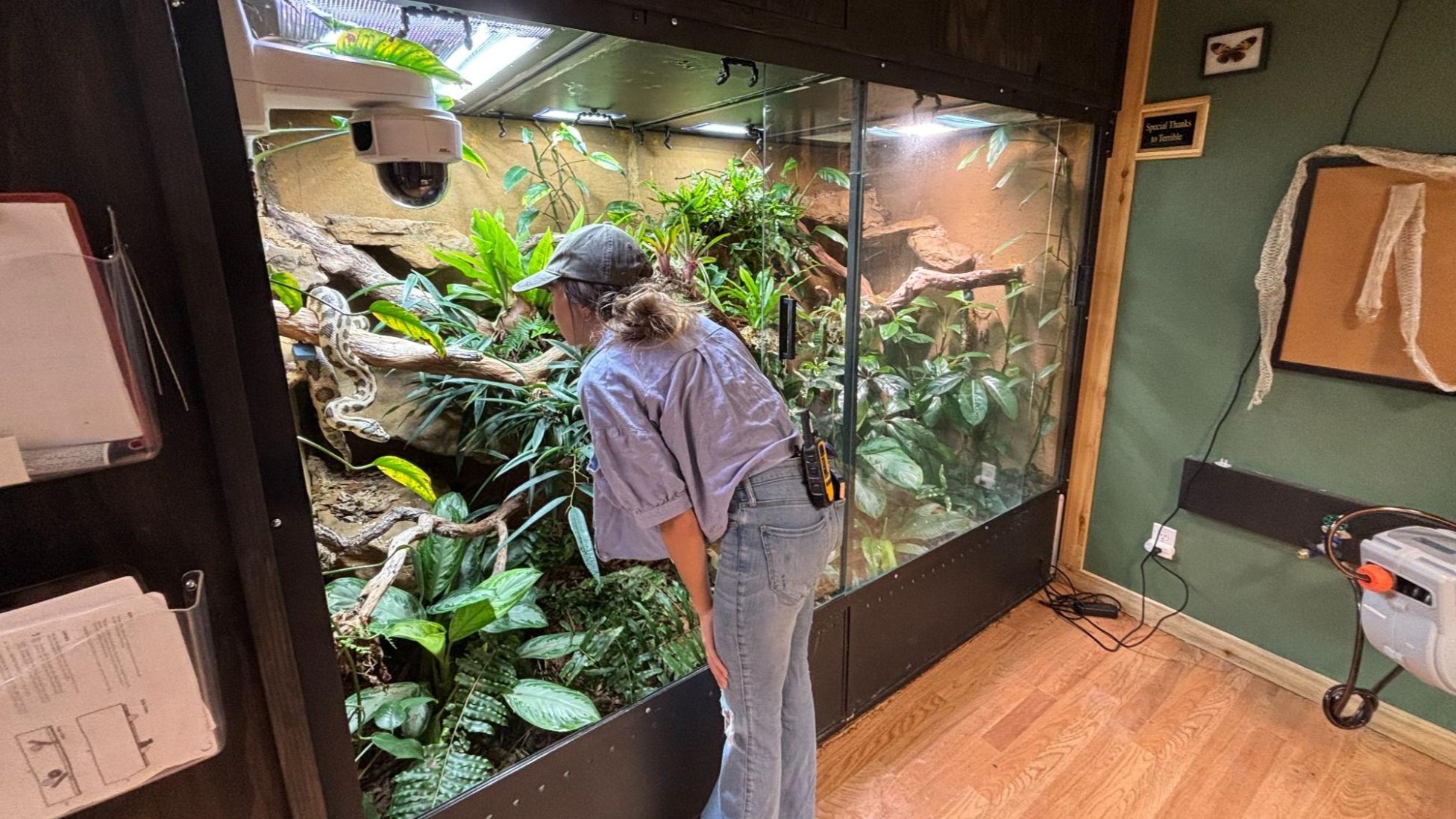
It’s then that I notice the cameras. High-definition lenses are mounted to fence posts and tucked into branches, continuously livestreaming the grounds. At that very moment, countless people across the world are staring at their screens, watching the exact same enclosures we are walking past.
Waiting for us is Stompy, a massive, fully grown emu. As Maya sinks into the dirt, the giant bird marches over and collapses forward, burying its head softly against her shoulder.
"Not being open to the public is incredible," she says, stroking Stompy’s feathers. "Our animals don't have to deal with the unpredictable factors that come with the public—like screaming kids and all the stressors of a zoo."
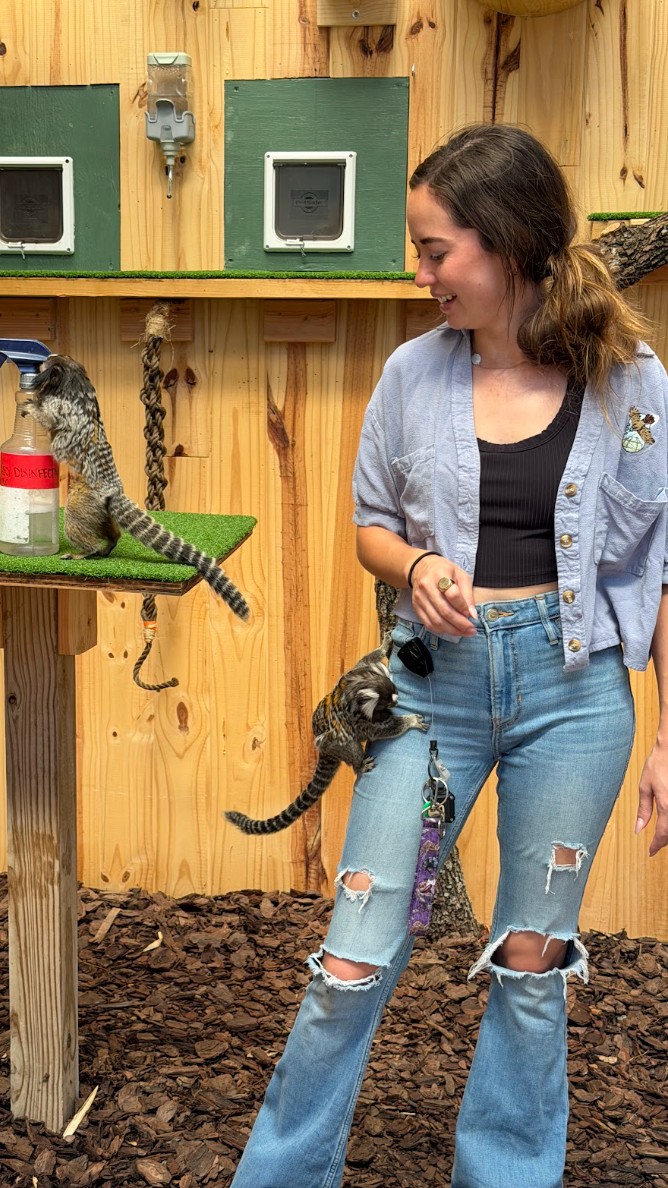
Leaving Stompy’s enclosure, Maya leads us through the grounds to show off her varied roster of "ambassadors". We pass by rehomed exotic birds, specialized enclosures for formerly neglected marmosets, and rescued wolf dogs, each space custom-tailored to its resident.
She points out the enclosure of Push Pop, a massive Sulcata tortoise. Positioned just inches from his feeding station is a specialized microphone—the "Crunch Cam"—which broadcasts the ASMR-like sounds of the tortoise crunching on lettuce. Nearby, interactive feeders allow a student in Tokyo or an office worker in London to click a button on their screen and physically drop a snack for an animal thousands of miles away.
"Winnie is an ambassador for cows. Momo is an ambassador for marmosets. I know for a fact next time you see an emu, you're gonna think of Stompy," Maya says as we head back toward the sanctuary's control room. "Once people have that individual connection to an animal, they care about the wild places they come from. They care about their wild counterpart, and then they care about the planet"
Thanks to creatively hidden cameras, Alveus has managed to create a kind of Truman Show effect for the animals. Thousands of humans are building deep, intensely loyal parasocial relationships with these creatures, investing towards their conservation, while the animals remain blissfully unaware of their fame.
"Originally, I would've thought the connection was hard, but now I don't really think that that's true," Higa admits as we step into the air-conditioned relief of the sanctuary’s main office. "You can visit a traditional zoo four or five times a year, and you leave and you don’t think about the animals. For our facility, people have them on every single day. They are a part of their lives. They see them often."
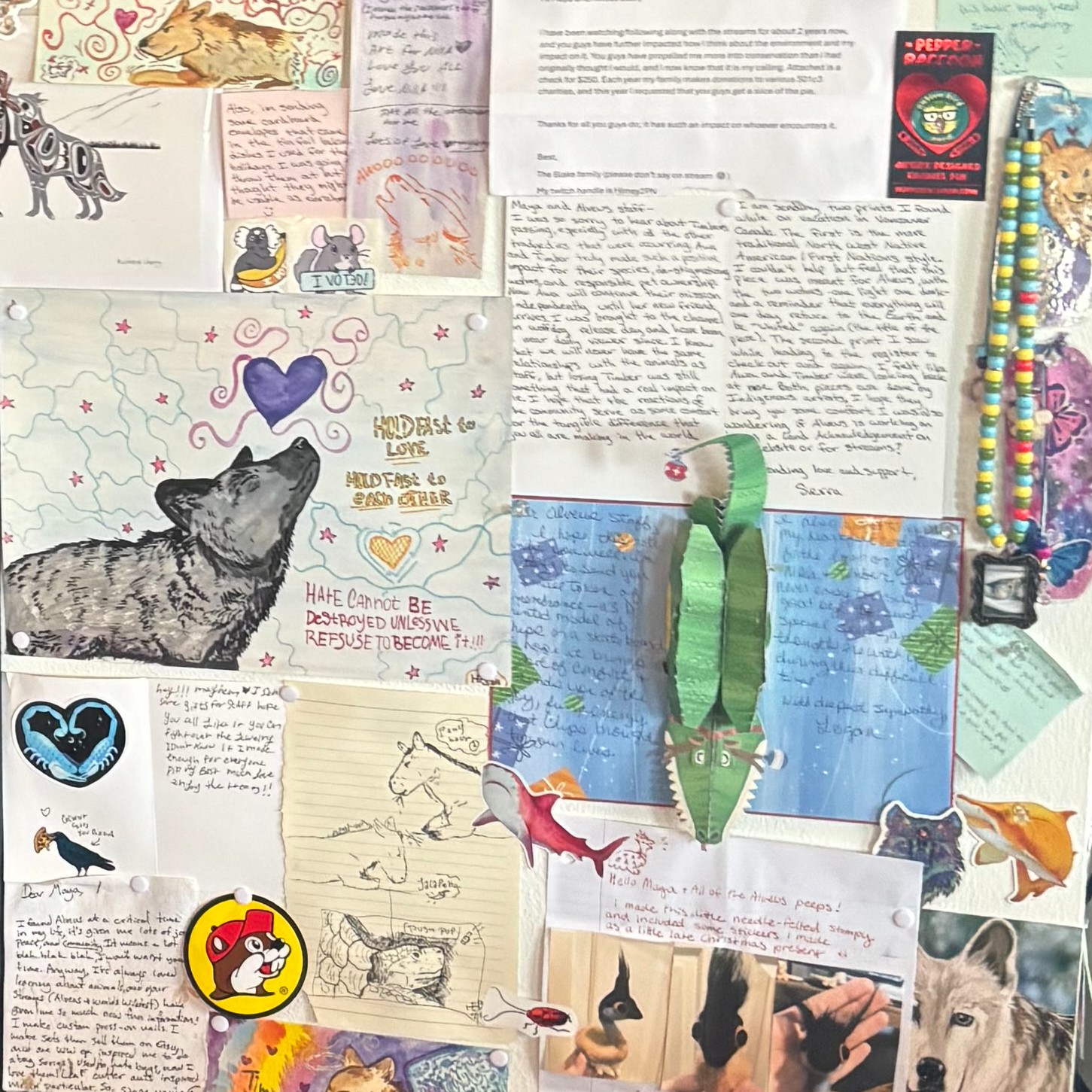
This virtual attachment manifests in a bound book Maya pulls from a shelf—a fan-coordinated memorial with dozens of intimate letters sent after the passing of a resident wolfdog and their beloved educational rats. Next to the text, fans printed custom QR codes that when scanned, pull up clipped archive videos of the animals' funniest moments on stream.
At just 27 years old, Higa has created a model for conservation and education that was previously unimaginable. It’s an achievement that has earned her a weighty title: the Gen Z Jane Goodall.
When I bring up the comparison, a rare flash of insecurity breaks through.
"It’s an honor, obviously, but it’s terrifying," she tells us. "Jane Goodall is a titan. I don't know how much you guys know of her story. She actually wasn’t a biologist by trade, yet she changed humanity’s entire relationship with nature, because she was seeing things in chimpanzees that scientists would turn their nose up to."
She pauses, nodding to herself.
"I think that if there's a comparison there, it's that she went out on a limb and did something cool and different that changed the way that people see wildlife. I’d really like to have even a fraction of that impact."
As our interview ends, Higa walks me back to the unmarked gates before heading back to the enclosures. She radios back to her team that the cameras can be switched back on. A few hours from now, the staff will go home, and the sanctuary will be pitch black. But the infrared lights will click on, the audio feeds will stay live, and somewhere someone will still be watching an emu sleep in the dark.